
The City-to-Country Buyer’s Guide: What Your Realtor Should Tell You
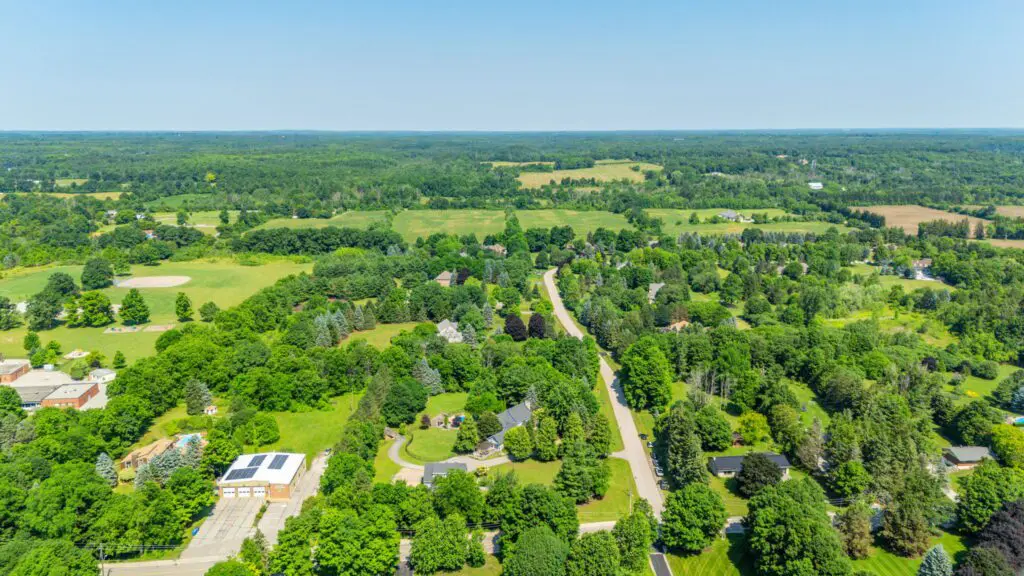
You’ve spent weekends driving through Carlisle. You’ve imagined winter mornings in Kilbride with a wood stove and five acres of quiet. You’ve scrolled listings in Flamborough and thought: this is it. More space, less noise, a different pace.
But between the dream and the closing date sits a set of operational realities that most city buyers don’t encounter until they’re already committed. Well water instead of municipal supply. Septic systems instead of city sewers. Heating costs that double what you paid in Burlington (although new alternatives can actually equalize this – read further to learn more). Fire response times measured in minutes, not seconds. Road maintenance that depends on whether you’re on a township road or a private lane.
This is the guide nobody hands you when you start looking at rural property in Ontario. It covers what changes when you leave the city, what costs more than you expect, and what questions to ask before you make an offer on acreage in Waterdown, an estate property in Carlisle, or a conservation-backed lot in Kilbride.
What happens when there’s no city water connection?
Most properties in Flamborough, Carlisle, Kilbride, and Campbellville rely on private well water. That means your water comes from a drilled well on your own property, not from a municipal treatment plant. You are responsible for the quality, the pressure, and the ongoing maintenance.
Before you close, insist on a current well water test. The standard test checks for bacteria (total coliforms and E. coli) and basic chemistry. It does not test for everything. If the property is near agricultural land, ask your inspector about nitrate testing. If there’s older infrastructure on-site, consider testing for lead or arsenic.
A good well produces 3 to 5 gallons per minute or more. Anything below 3 gallons per minute can struggle to support a household with multiple bathrooms, laundry, and irrigation. It’s a reality for some properties. In those cases, home owners usually support this with cisterns (storage tanks for water), that can supplement water flow to the house. Water can be trucked in in extreme cases.
Ask the seller for the well log (the driller’s record showing depth, yield, and static water level). If they don’t have it, the Ministry of the Environment’s well record database may have a copy.
Well maintenance is not expensive, but it is your responsibility. Expect to budget $150 to $300 every few years for a pressure tank inspection or replacement. If the well pump fails, replacement can cost $1,500 to $3,000 depending on depth. Most wells in this region are drilled between 60 and 200 feet.
The good news is that you don’t have to pay for municipal water fees, which have been on the rise in urban areas. You’ll likely find that you come out ahead cost-wise.
How does septic work, and what does it cost to maintain?
If you’re coming from a home connected to municipal sewers, septic is the single biggest operational shift you’ll face. Your wastewater doesn’t leave the property. It flows into a septic tank (usually 1,000 to 1,500 gallons), where solids settle and bacteria break down waste. The liquid effluent then moves into a leaching bed (also called a tile bed or drain field), where it filters through soil.
Septic systems require pumping every 3 to 5 years. That costs $300 to $500 in this region. If you skip it, solids overflow into the leaching bed, which can cause a failure that costs $15,000 to $30,000 to replace.
Before you buy, hire a septic inspector. They will locate the tank, measure sludge levels, and assess the condition of the distribution box and leaching bed. If the system is more than 20 years old, ask pointed questions. Older systems were often undersized by today’s standards, and many were installed before modern regulations required separation distances from wells and property lines.
Do not assume the seller knows where the septic system is. Many rural property owners have never had the tank pumped or inspected. If the inspector can’t locate the system, that’s a red flag, not a minor inconvenience. Inspectors can locate the septic tank, but they can take more time digging through the property to find it if it’s not known.
What does heating cost on a rural property in Ontario?
Heating a 2,500-square-foot home in Carlisle or Flamborough will often cost more than heating the same square footage in a suburban subdivision. Rural homes are often older, less insulated, and built before modern energy codes. Many sit on exposed lots where wind increases heat loss.
If the property uses oil heat, expect to pay $3,000 to $5,000 per winter depending on oil prices and how well the home is insulated. Propane costs vary but typically run $2,500 to $4,000 per season for a similar-sized home. Natural gas is available in parts of Waterdown and Carlisle but not on most rural concession roads.
Wood heat is common in this region, either as primary heat or as a supplement. A good woodstove or insert can significantly reduce heating costs if you’re willing to source, split, and stack your own wood. Expect to burn 4 to 6 full cords per winter if wood is your primary heat source. Buying seasoned hardwood costs $400 to $600 per cord delivered.
A modern addition to supplement rural home comfort are heat pumps. They are called heat pumps because they move heat from one location to another – out of your home in the summer and into your home in the winter. Even when it’s cold, the air still holds heat energy. Heat pumps are surprisingly effective even in Canadian winters.
The cost to run a heat pump varies, but it can vary from $750 to $1500 per heating season. Many rural home owners are now adding heat pumps to their homes, and only using oil heat on the coldest of days. Nothing beats sitting by a fireplace with a café au lait though, so don’t let the heat pump stop you.
Ask the seller for recent heating bills. If they say they “don’t really track it” or “we keep it cold,” assume costs will be higher than you expect. Budget accordingly.
How long does it take emergency services to reach a rural property?
Fire response times in rural Flamborough and Carlisle are longer than in urban Hamilton, Burlington, or Waterdown. The nearest fire station may be 10 to 15 minutes away, and volunteer firefighters may need to respond from home before the truck leaves the station.
This affects your homeowner’s insurance. Rural properties often pay higher premiums because of distance from fire services and limited access to hydrants. Some insurers require a minimum water supply on-site (a pond, cistern, or dry hydrant) to qualify for coverage. If the property relies entirely on well water with low flow, you may face higher premiums or coverage restrictions.
Ambulance response follows a similar pattern. If someone has a medical emergency on a property outside Waterdown or Carlisle’s core, expect a 15 to 25-minute response time depending on where the nearest ambulance is stationed.
This is not a reason to avoid rural property. It is a reason to know your risks, keep a well-stocked first aid kit, and understand that self-reliance is part of the trade-off.
Who maintains the road you live on?
Not all roads in rural Ontario are maintained the same way. Township roads (maintained by the City of Hamilton or City of Burlington) are plowed in winter, graded periodically, and repaired as needed. Private roads and shared laneways are the responsibility of the property owners who use them.
If the property is accessed by a private road, ask who pays for maintenance. Is there a formal cost-sharing agreement? Who plows in winter? What happens if the road washes out after a heavy rain? These are not theoretical questions. Poorly maintained private roads can become impassable in winter or spring, and repair costs can run into the thousands.
Some rural properties sit on unopened road allowances (roads that exist on paper but were never built or maintained by the municipality). If you’re looking at vacant land or a property with an unusual access configuration, confirm the legal status of the road before you make an offer.
What does Conservation Authority jurisdiction mean for your property?
Many properties in Kilbride, Carlisle, and Flamborough back onto conservation land or fall within a regulated area under Conservation Halton or Hamilton Conservation Authority. This is often a selling feature (privacy, natural views, trail access), but it also comes with restrictions.
If your property includes a watercourse, wetland, floodplain, or steep slope (common along the Niagara Escarpment), you may need a permit from the conservation authority before you build a deck, install a pool, grade the land, or remove trees. Regulated areas typically extend 15 to 30 metres from the edge of a watercourse or the boundary of a wetland.
Do not assume you can build on every part of your lot. Before you buy, ask the listing agent whether any part of the property is within a conservation authority regulated area. If the answer is yes (or “I’m not sure”), contact the relevant authority and request a property-specific inquiry. This is free and takes less than a week.
Properties that back onto conservation land without being subject to on-site restrictions are the ideal scenario: you get the view and the privacy without the permitting complexity.
Can you get reliable internet on a rural property?
Internet access in rural Flamborough and Carlisle has improved significantly in the past five years, but it is not uniform. Some areas have fibre and this is improving quickly. Some have cable. Some rely on fixed wireless or satellite. As cellular service has improved some providers are offering home internet through cellular connected modems.
If you work from home, internet reliability is not optional. Before you make an offer, contact the major providers (Rogers, Bell, Cogeco, Starlink, and others) and confirm what service is available at the specific address. Do not rely on the seller’s experience. They may have low expectations, or they may be using a legacy connection that is no longer offered.
Starlink (satellite internet) is now widely available in this region and offers speeds of 50 to 200 Mbps with relatively low latency. Many rural buyers use it as a primary connection or as a backup. Monthly cost is approximately $140.
What does the lifestyle adjustment actually feel like?
The operational details matter, but so does the lived experience. Moving from suburban Mississauga or Burlington to rural Flamborough is not just a change of address. It is a change in daily rhythms.
You will drive more. Grocery runs that took 10 minutes now take 25. Your kids’ friends may live 15 minutes away instead of three doors down. You will become very familiar with the price of gas. (Or really love your EV or Hybrid.)
Yard maintenance takes more time or more cost. Larger properties require more upkeep and more tools. You might get a lawn tractor instead of a lawn mower. Or become good friends with a property maintenance company.
You will notice darkness. If you’ve lived under streetlights your entire adult life, the first few weeks of true rural darkness can feel disorienting. You will also notice quiet. No traffic hum. No sirens. No neighbours’ air conditioners.
You will learn seasonal rhythms you didn’t know existed. Mud season in early spring. The way snow drifts across open fields. The sound of coyotes in January. The moment in late April when the peepers start.
You will become more self-reliant. You will learn to check your own oil tank level. You will know which breaker controls the well pump. You will keep a backup supply of drinking water in the basement.
For some buyers, this adjustment is energizing. For others, it is harder than expected. If you have young children, think carefully about school bus routes and activity access. If you or your partner are deeply social and rely on spontaneous plans, rural life may feel isolating.
The best rural buyers are the ones who visit the property at different times of day, in different seasons, and ask themselves: do I want to live this specific life, or do I just want to escape the one I have now?
What questions should you ask before making an offer?
Before you make an offer on a rural property in Carlisle, Kilbride, or Flamborough, ask the listing agent (or have your own agent ask) the following:
When was the well last tested, and what were the results? When was the septic system last pumped and inspected? Is any part of the property within a Conservation Authority regulated area? Is the road municipally maintained or private? If private, is there a cost-sharing agreement? What is the primary heating source, and what were the heating costs last winter? Is the property in the Greenbelt or subject to any agricultural zoning restrictions? Are there any easements, rights of way, or encroachments on the property? What internet service is available at this address?
These questions will not kill a deal. They will clarify what you’re actually buying and what costs to expect in the first few years of ownership.
How do you find the right rural property in this region?
The rural corridor from Kilbride through Carlisle, Flamborough, Waterdown, and Campbellville is not homogeneous. A two-acre property in Kilbride with municipal services feels very different from a 10-acre estate in Freelton with a private well, septic, and propane heat.
The best way to navigate this market is to work with an agent who lives in these communities and understands the operational nuances of rural property. Not someone who occasionally lists a country home. Someone who knows which roads flood in spring, which conservation authority regulates which area, and what a reasonable price looks like for five acres with a barn in Millgrove.
That’s the work we do. We live here. We know these roads. And we’ve helped dozens of city buyers make the transition to rural life without surprises they didn’t see coming.
—
Frequently Asked Questions
Do I need a special type of home insurance for a rural property?
Yes. Rural properties often require specialized insurance because of distance from fire services, reliance on well and septic, and exposure to risks like ice dams, frozen pipes, and wildlife damage. Some insurers require a minimum water supply on-site (such as a pond or cistern) to provide full coverage. Expect to pay 20% to 40% more for rural home insurance compared to a similar-sized suburban home. Always get a quote before you firm up an offer.
Can I use my property for horses or other animals?
It depends on the zoning and lot size. Most rural residential properties in Flamborough and Carlisle allow for personal livestock (horses, chickens, goats) as long as you meet minimum lot size and setback requirements. Zoning bylaws typically specify how many animals are permitted per acre and how far structures like barns or coops must be from property lines. If equestrian use is important to you, confirm zoning and ask about water access for paddocks before you make an offer.
What happens if my well runs dry?
Wells in this region rarely run completely dry, but yields can drop during extended droughts or if neighbouring wells are drilled deeper. If your well’s yield drops significantly, a licensed well contractor can often deepen the existing well or install a larger storage tank to manage lower flow rates. In rare cases, a new well may need to be drilled. Costs range from $8,000 to $15,000 depending on depth and site conditions. Well recovery is usually covered by insurance only if the failure is sudden and accidental, not gradual.
How do I know if a property is in the Greenbelt?
You can check Greenbelt designation by visiting Ontario’s Greenbelt Plan mapping tool or asking your real estate agent to pull a planning report. Properties within the Greenbelt are subject to land use restrictions that limit severances, new development, and changes to agricultural use. Most rural residential properties in Carlisle, Flamborough, and Kilbride fall within the Greenbelt, but existing homes and lots of record are generally permitted uses. If you’re buying vacant land or considering future severance, Greenbelt status matters.
Is rural property a good investment?
Rural property in this region has shown consistent long-term value appreciation, particularly for well-maintained acreage and estate properties near conservation lands. However, rural real estate is less liquid than urban property (fewer buyers, longer days on market), and carrying costs (heating, maintenance, insurance) are higher. If you’re buying as a primary residence and plan to stay for at least five to seven years, the market has historically been stable. If you’re buying purely as a short-term investment, rural property is not the right fit.